
What Can MRD Tell Us After Treatment for Hairy Cell Leukemia?
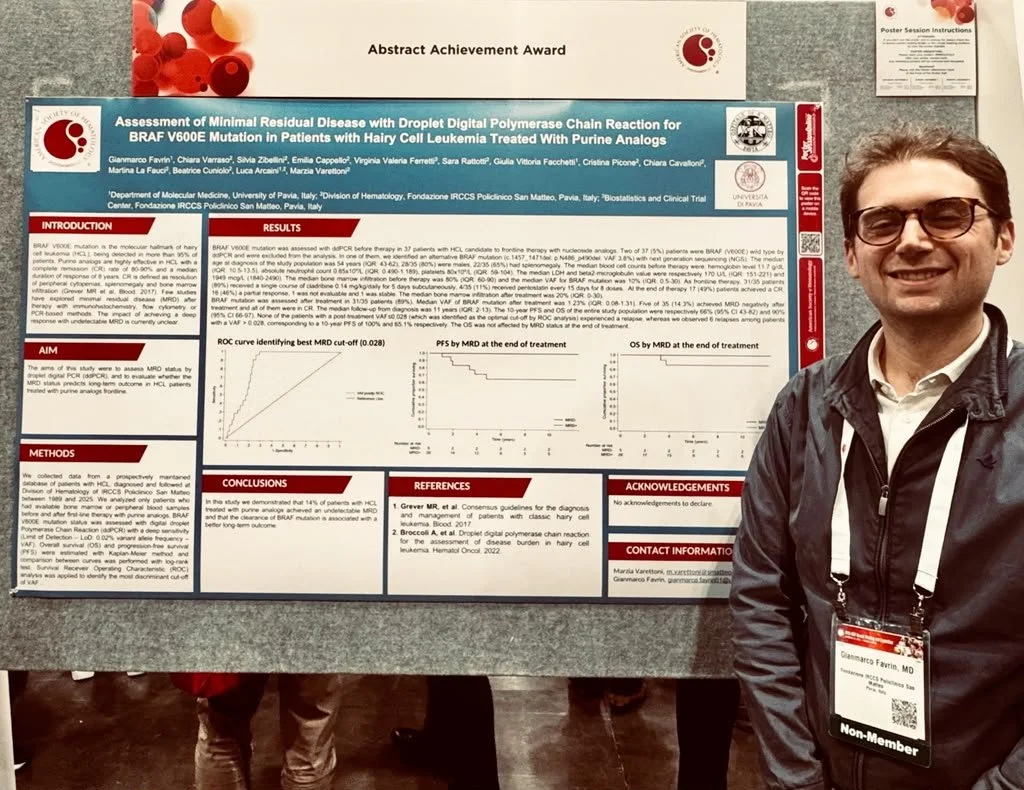
Gianmarco Favrin, MD, stands beside research on MRD in HCL presented at ASH 2025. The research received an ASH Abstract Achievement Award.
In our fourth post in the ASH 2025: HCL Takeaways series, we turn to a topic that many people with Hairy Cell Leukemia (HCL) are hearing more about: measurable residual disease, or MRD¹.
Researchers from the University of Pavia and Fondazione IRCCS Policlinico San Matteo in Pavia, Italy, including first author Gianmarco Favrin and colleagues, studied whether a highly sensitive test for the BRAF V600E mutation² could detect very small amounts of HCL remaining after first-line treatment and whether those results might help predict how patients do over time.
Their findings offer an interesting look at the potential role of MRD testing in HCL. At the same time, the study addresses an important question that researchers are still working to answer:
Does having less detectable disease after treatment translate into better long-term outcomes?
Why MRD matters in HCL research
Most people with classic HCL have a genetic change called BRAF V600E². Because this mutation is present in more than 95% of patients with classic HCL, researchers can use it as a molecular marker to detect very small amounts of residual leukemia after treatment.
This is where MRD testing comes in.
A patient can achieve a complete remission (CR)³, meaning blood counts have recovered, an enlarged spleen has resolved, and HCL is no longer detected by standard tests, even though more highly sensitive laboratory tests may still find a very small number of leukemia cells.
That small amount is called measurable residual disease (MRD)¹.
Researchers are interested in MRD because it may provide information about the depth of a patient's response. However, an important distinction for patients is that detecting MRD does not mean the patient is in relapse or needs more treatment.
In fact, the researchers behind this study noted that the clinical impact of achieving undetectable MRD⁴ in HCL remains unclear. Their study was designed to help answer that question.
How was the study conducted?
The researchers reviewed patients with HCL who had been diagnosed and followed at the Division of Hematology at IRCCS Policlinico San Matteo between 1989 and 2025.
The analysis included 35 patients with BRAF V600E-positive HCL who had samples available before and after their first treatment with a purine analog⁵.
The median age at diagnosis was 54 years, and 80% of participants were men. Most patients received cladribine, while a smaller number received pentostatin.
Researchers then used a highly sensitive technique called droplet digital polymerase chain reaction (ddPCR⁶) to measure the BRAF V600E mutation before and after treatment.
Think of ddPCR as a very sensitive molecular search tool. Instead of looking only for evidence of HCL visible with conventional testing, it searches for tiny amounts of the BRAF V600E mutation that can serve as a signal that HCL cells remain.
Patients were followed for a median of 11 years, giving researchers an opportunity to compare these molecular findings with long-term outcomes.
Key takeaways from the study
1. A very sensitive blood or bone marrow test can detect small amounts of HCL after treatment
The researchers successfully used ddPCR⁶ to measure how much of the BRAF V600E mutation remained after treatment.
Before treatment, the median level of the BRAF mutation measured by the test was 10%. After treatment, it fell substantially, with a median of 1.23% among those assessed after therapy.
This demonstrates how molecular testing can provide researchers with information about the depth of a patient's response beyond what standard response measurements alone may show.
2. Only a small group had completely undetectable MRD after purine analog treatment (monotherapy)
Among the 35 patients in the study, five, or approximately 14%, achieved undetectable MRD⁴ after treatment. All five of these patients were also in complete remission.
It is important to put that number into context.
Most participants received a purine analog alone, primarily cladribine. Therefore, these findings should be understood within the treatment approaches used in this particular patient group and should not automatically be applied to patients receiving today's different combination or targeted treatment strategies.
The fact that most patients still had some detectable BRAF V600E after treatment also does not mean their treatment failed. Many patients continued to have durable disease control.
3. Lower levels of detectable BRAF after treatment were associated with longer remission
This was perhaps the most interesting finding of the study.
Researchers identified a very low post-treatment BRAF V600E level that appeared to separate patients into groups with different long-term outcomes.
None of the patients at or below this very low level experienced a relapse during the study follow-up. In comparison, six relapses occurred among patients whose BRAF level remained above that threshold. At 10 years, progression-free survival (PFS)⁷ was 100% in the lower-level group compared with 65.1% in the higher-level group.
The study suggests that how much HCL remains detectable after treatment may provide information about how long a remission could last.
However, this was a relatively small study of 35 patients. These findings need to be confirmed in larger groups before a particular MRD measurement can be used to predict what will happen for an individual patient.
4. MRD was associated with disease control, but not overall survival
There is another important part of the results that can help put MRD into perspective.
Lower or undetectable BRAF V600E after treatment was associated with longer progression-free survival in this study.
That distinction matters.
For someone living with HCL, an MRD-positive result can understandably sound concerning. But this study does not show that detectable MRD means a patient will have a shorter life.
Instead, the findings suggest that MRD may eventually become one of several tools doctors and researchers can use to better understand the depth and possible durability of a treatment response.
What this means for patients
MRD is becoming an increasingly important part of HCL research, but it is important to understand what it can and cannot tell us today.
This study provides evidence that very low or undetectable levels of MRD after first-line purine analog treatment may be associated with longer periods without disease progression.
At the same time, several findings offer important perspective:
MRD is not the same as relapse. A sensitive test can detect a very small amount of HCL even when a patient is doing well clinically.
MRD positivity does not automatically mean another treatment is needed. Treatment decisions in HCL are based on the patient's overall clinical situation, not simply on the result of a single highly sensitive molecular test.
MRD-negative results may provide useful information about the depth of remission. In this study, patients with the lowest post-treatment BRAF levels experienced particularly durable disease control.
More research is needed. With only 35 patients included in this analysis, larger studies will be important to determine how MRD testing should ultimately influence routine HCL care.
For patients, the most useful takeaway may therefore be that MRD gives researchers another window into what is happening after treatment, but it is one piece of a much larger picture.
Looking ahead
As HCL treatments become increasingly effective and produce deeper remissions, researchers are asking more sophisticated questions.
It is no longer only, "Did the treatment work?"
Researchers also want to know: How deep was the response? How long is it likely to last? And can highly sensitive tests help identify which patients may need closer monitoring or different treatment approaches in the future?
Studies like this one are helping build the evidence needed to answer those questions.
For people living with HCL, this progress could eventually lead to more personalized follow-up strategies, in which monitoring is informed not only by blood counts and symptoms but also by a deeper understanding of each patient's disease biology.
For now, MRD remains an evolving area of HCL research, and patients who have questions about their MRD results should discuss what those findings mean in their individual situation with their HCL specialist.
Glossary
¹ Measurable Residual Disease (MRD): A very small amount of leukemia that remains after treatment and can only be detected using highly sensitive tests.
² BRAF V600E: A genetic change found in more than 95% of people with classic HCL. In this study, researchers used it as a marker to detect very small amounts of remaining HCL.
³ Complete Remission (CR): A strong response to treatment in which the signs of HCL used to assess remission are no longer detectable.
⁴ Undetectable MRD / MRD-negative: When a sensitive test does not detect evidence of remaining leukemia. This does not necessarily mean that every leukemia cell is gone.
⁵ Purine Analog: A type of treatment commonly used for HCL. Cladribine and pentostatin are purine analogs.
⁶ ddPCR (Droplet Digital Polymerase Chain Reaction): A highly sensitive laboratory technique used in this study to measure very small amounts of the BRAF V600E mutation.
⁷ Progression-Free Survival (PFS): The length of time after treatment that a patient lives without the disease progressing.
Continue the ASH 2025 HCL Takeaways series
This is the fourth article in our series translating research presented at ASH 2025 into practical, patient-friendly information.
You can also explore our earlier posts:
Post #1: Long-term results of cladribine plus immediate rituximab and what they tell us about deep, durable remissions. Click here to read Post #1 >>
Post #2: MAP2K1 and MAP2K2 gene changes and what researchers are learning about different molecular forms of HCL. Click here to read Post #2 >>
Post #3: More than 20 years of follow-up after first-line cladribine and what those data tell us about remission, relapse, and long-term survivorship. Click here to read Post #3
Together, these studies show how HCL research is moving beyond whether a treatment works toward understanding how deeply it works, how long its benefits last, and how care can become increasingly personalized for each patient.
Source: Favrin G, et al. “Assessment of minimal residual disease with droplet digital polymerase chain reaction for BRAF V600E mutation in patients with hairy cell leukemia treated with purine analogs.” ASH 2025, Publication #1832.